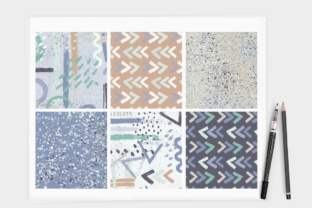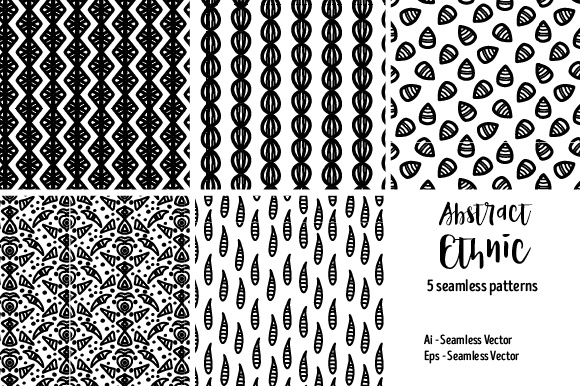
5 Abstract Ethnic Seamless Pattern: A Practical Resource for Designers and Creators
When you're developing a textile line, launching branded packaging, or designing stationery for a boutique client, pattern quality directly impacts perception, production speed, and final output fidelity. The 5 Abstract Ethnic Seamless Pattern set meets that need precisely—not as a decorative afterthought, but as a functional, production-ready asset built into your creative workflow from the start.
These aren’t generic repeats or AI-generated approximations. Each of the five patterns is hand-painted first, then meticulously vectorized and tested for true seamlessness in Adobe Illustrator. That origin matters: it means organic line variation, intentional color layering, and cultural texture grounded in real artistic process—not algorithmic mimicry. You get both aesthetic authenticity and technical reliability in one package.
Where This Set Fits in Your Real-World Workflow
Designers often treat patterns as late-stage polish—something added after layout, color, and typography are locked. But with the 5 Abstract Ethnic Seamless Pattern, integration happens earlier and more intentionally. For example:
- During concept development: Use one of the EPS files as a background layer in mood boards or pitch decks to quickly convey visual tone without committing to custom illustration.
- In prototyping: Apply a pattern directly to a mockup of a tote bag, notebook cover, or soap wrap to assess scale, contrast, and rhythm before ordering physical samples.
- At production handoff: Deliver the native Illustrator file (.ai) alongside your print spec sheet—no conversion needed, no raster fallbacks, no scaling artifacts.
This isn’t about shortcuts. It’s about reducing friction between intention and execution—so your focus stays on storytelling, brand alignment, and user experience, not troubleshooting tiling errors or pixelated exports.
Compatibility and Technical Readiness
The set includes five vector EPS files and five corresponding Adobe Illustrator (.ai) files—both formats fully editable, scalable to any size, and compatible with industry-standard workflows. EPS ensures broad compatibility (especially with older RIP software used in textile printing), while the Illustrator files retain layers, swatches, and named artboards—useful if you’re adjusting color palettes for seasonal variants or accessibility compliance.
No fonts, embedded rasters, or external links. Everything is self-contained. That means:
- You can recolor patterns non-destructively using Global Swatches in Illustrator.
- You can isolate motifs using the Pathfinder panel to extract elements for logos or icons.
- You can export at 300 DPI for print or 72 DPI for web previews—without re-rasterizing or losing crispness.
If you’re collaborating with a printer, manufacturer, or developer, this consistency eliminates back-and-forth about file readiness. It also supports version control: save your edited .ai files with clear naming (e.g., “EthnicPattern_03_TealVariant.ai”) so future iterations stay traceable and organized.
Practical Implementation Across Use Cases
Textile design: Import a pattern into your fabric simulation software (like Browzwear or CLO) using the EPS as a repeat tile. Adjust scale in-context to see how motif density changes drape or visual weight—critical when working with linen, cotton voile, or performance knits.
Packaging and labeling: Apply the pattern as a subtle background on a product label or gift box. Because the repeat is truly seamless and low-noise, it won’t distract from key information like ingredients, certifications, or QR codes—even at small sizes.
Stationery and paper goods: Use one pattern as a watermark layer behind letterhead text, or scale it down to 15% opacity for a tactile, artisanal feel on business cards or thank-you notes. The hand-painted origin adds warmth that pure geometric patterns often lack.
Digital assets: Export SVG versions for use in web banners or email headers. Since the original vectors are clean and minimal in anchor points, SVG file size stays lean—no bloated code slowing down load times.
Integration With Other Tools and Assets
The 5 Abstract Ethnic Seamless Pattern doesn’t exist in isolation. It works best when paired with intentional systems:
- Color management: Pull base hues from the patterns into your brand palette library (e.g., in Adobe Color or Coolors). Their earthy ochres, indigo washes, and terracotta accents translate well to Pantone Solid Coated references—making cross-media consistency easier.
- Asset organization: Store the files in a dedicated “Patterns/Seamless/Ethnic” subfolder within your master design assets library. Name each file clearly (e.g., “Pattern_Ethnic_Abstract_04.ai”) to avoid confusion during team handoffs.
- Workflow automation: If you use Adobe Libraries or Figma’s shared libraries, import swatches and pattern swatches there—so they’re accessible across projects without repeated file navigation.
It also complements—not replaces—custom illustration work. Think of these patterns as reliable foundational textures. When a client needs a unique logo mark or campaign-specific icon set, you’ve already solved the background texture problem, freeing mental bandwidth for higher-value creative decisions.
Long-Term Usability and Quality Control
Because these are vector-based and hand-crafted, they age well. Unlike raster patterns that degrade with resizing or format shifts, these remain production-safe whether you’re printing on recycled kraft paper in 2024 or laser-etching onto bamboo packaging in 2027.
To maintain quality over time:
- Always edit the Illustrator file—not exported JPEGs or PNGs—when adjusting colors or scale.
- Test prints at actual size before bulk runs. Even seamless patterns can reveal subtle misalignments on certain substrates (e.g., uncoated paper vs. metallic foil).
- Archive both the original and edited versions. Label edited files with date and purpose (e.g., “Pattern_02_CoralEdit_20240512.ai”).
Also note: These patterns are designed with cultural respect in mind. They abstract form and rhythm rather than appropriating sacred symbols or ceremonial motifs. That integrity supports ethical branding—especially important for educators, nonprofits, and socially conscious businesses building trust through thoughtful design choices.
Making It Part of Your Routine
You don’t need to overhaul your process to benefit from the 5 Abstract Ethnic Seamless Pattern. Start small:
- Add one pattern to your next client presentation as a subtle slide background—see how it influences tone without saying a word.
- Use the EPS version to generate a quick fabric swatch PDF for internal review before commissioning a custom weave.
- Drop a scaled-down version into your email signature banner to reinforce visual identity across communications.
Over time, you’ll notice fewer last-minute texture revisions, faster approval cycles, and more confident decisions about materiality and finish. That’s not just efficiency—it’s the quiet confidence that comes from having the right tool, ready, at the right moment.
Whether you’re launching a small-batch apparel line, designing curriculum materials with global themes, or refreshing your freelance portfolio, the 5 Abstract Ethnic Seamless Pattern delivers tangible value—not as decoration, but as infrastructure for thoughtful, scalable, human-centered design.