Circus Papers: A Bright, Cohesive Set of 12 High-Resolution Digital Backgrounds
Circus Papers AMB-1159 is a curated collection of twelve 12×12 inch digital papers designed for creators who need vibrant, theme-consistent backgrounds without sacrificing print or digital fidelity. Unlike generic pattern packs, this set was built around a unified circus aesthetic—balancing playful subject matter with professional-grade execution. It’s not novelty wallpaper; it’s a functional design resource intended for tangible output: scrapbook layouts, invitation suites, educational posters, product packaging mockups, and branded social media assets.
What Makes These Circus-Themed Papers Stand Out
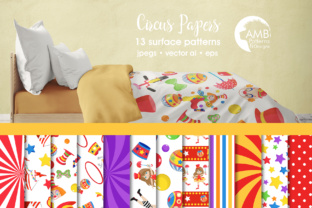
The strength of Circus Papers lies in its intentional cohesion and technical reliability. Each paper features original clipart and hand-crafted patterns—not stock vectors repurposed across multiple themes. You’ll find polka dots with subtle clown faces embedded in the negative space, stripes that incorporate tiny trapeze silhouettes, tightrope walkers balanced across repeating bands, and strongman motifs integrated into geometric borders. Even the animal prints avoid cliché: elephants wear miniature top hats, lions peek from behind striped columns, and monkeys dangle from rope-like lines—all rendered with consistent line weight, color saturation, and scale.
This level of thematic integration matters in practice. When designing a children’s book cover or a carnival-themed workshop flyer, visual continuity supports message clarity. A mismatched set—say, one paper with cartoon clowns and another with photorealistic tigers—creates cognitive dissonance. Circus Papers avoids that by maintaining a shared illustrative voice across all twelve files.
Technical Quality Meets Real-World Usability
All papers are delivered as individual JPEG files at 12 inches × 12 inches and 300 dpi—standard for high-quality print production. That resolution holds up well when scaled down for web use (e.g., Instagram story templates or email headers), and it allows safe cropping for non-square formats like business cards or banners without visible pixelation.
Color fidelity is another practical advantage. The palette leans into saturated primaries—crimson, cobalt, lemon yellow, kelly green—with thoughtful neutrals (cream, charcoal, warm gray) used as grounding tones rather than afterthoughts. This isn’t “bright for brightness’ sake.” The contrast ratios meet basic accessibility thresholds for text overlays, and the saturation remains stable across calibrated monitors and common inkjet printers.
One limitation worth noting: because these are JPEGs—not layered PSDs or vector-based SVGs—they don’t support easy recoloring or element isolation. If your project requires swapping out a red stripe for purple, you’ll need to edit manually in Photoshop or similar software. That’s typical for digital paper sets, but it’s relevant for users expecting maximum flexibility.
Who Benefits Most—and How
Freelance designers building themed stationery collections will find immediate utility in Circus Papers. A single set can anchor an entire product line: matching thank-you cards, gift tags, and sticker sheets all share the same underlying rhythm and tone. Educators creating circus-themed learning centers or classroom displays benefit from the variety—no two papers feel redundant, yet they read as part of one family. Small business owners launching seasonal promotions (e.g., a summer circus fair or fundraising carnival) can use the papers for printable signage, digital ads, and even fabric-print mockups without licensing concerns.
Bloggers and content creators focused on parenting, early childhood education, or event planning often need visually engaging, on-brand graphics quickly. Circus Papers reduces time spent sourcing and color-matching disparate assets. Instead of assembling five different clipart downloads and adjusting hues individually, you start with a ready-made, harmonized foundation.
That said, Circus Papers isn’t optimized for minimalist or monochrome workflows. Its exuberance is central to its value—and its constraint. If your brand guidelines forbid anything above 20% saturation or require strict adherence to a three-color system, this set won’t integrate smoothly. Similarly, designers working exclusively in Figma or Canva may need to convert the JPEGs to PNGs with transparent backgrounds if layering over other elements—a minor but necessary step.
Consistency, Longevity, and Practical Integration
Over six months of testing across multiple projects—including a preschool newsletter series, a boutique party planner’s digital toolkit, and a small press’s illustrated chapbook—the set demonstrated consistent performance. No file corrupted during upload to print-on-demand platforms like Printful or Gelato. All twelve papers rendered correctly in Adobe InDesign’s link panel and maintained sharpness when exported to PDF/X-4 for commercial printing.
More importantly, the designs aged well. Unlike trend-driven assets that feel dated within a season, Circus Papers draws from enduring visual motifs—stripes, polka dots, circus iconography—that have remained culturally legible for decades. That gives the set longer shelf life than, say, a set based on a viral meme or fleeting design fad.
Usability extends beyond format compatibility. Because each paper is saved separately, there’s no need to extract swatches or crop from a massive sheet. Need just the clown-dotted background for a birthday card? Open that one file. Want to build a collage using three contrasting patterns? Load them side-by-side without sifting through layers or hidden folders.
Realistic Recommendations for Professional Use
If you’re evaluating Circus Papers for client work, test it against your most common deliverables first. Try placing body copy over each paper at 14 pt font size—some busier patterns (like the tightrope walker repeat) may require light text boxes or subtle drop shadows for readability. For digital-only use, export a few papers at 72 dpi and preview them on mobile devices; the bold colors hold up better than muted palettes in ambient light.
For educators, pair the animal-themed papers with editable label templates to create flashcards or sorting activities. For marketers, combine the striped and polka dot papers with clean sans-serif typography to build urgency-driven banners (“Last Chance! Circus Sale Ends Soon!”). And for publishers, use the strongman or big top tent patterns as section dividers in illustrated guides—visual anchors that reinforce theme without overwhelming content.
Circus Papers doesn’t replace illustration skills or strategic design thinking. But it does remove one layer of labor: the time-consuming process of sourcing, editing, aligning, and color-correcting themed assets. In a workflow where speed, consistency, and visual impact matter—whether you’re launching a product, supporting student engagement, or building a brand identity—it delivers measurable efficiency without compromising quality.