Unicorn Papers: Pastel Magic for Purpose-Driven Design Projects
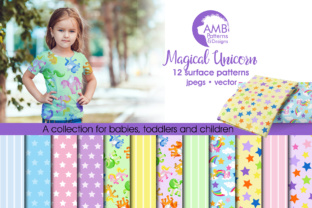
When color, intention, and functionality converge, design becomes more than decoration—it becomes a tool for connection, clarity, and care. Unicorn Papers exemplify this convergence: a curated collection of 12 original, high-resolution patterned papers—each measuring 12 inches by 12 inches at 300 dpi—crafted in soft, emotionally resonant pastel nursery colors. These aren’t generic stock patterns. Every swirl, horn, starburst, and cloud is drawn from scratch using custom clipart and hand-refined digital illustration techniques. The result? A cohesive yet distinct set of visual assets designed not just to please the eye, but to serve real-world creative needs across diverse professional and personal contexts.
Why Pastel Nursery Colors Matter Beyond Aesthetics
Pastel nursery colors—think muted lavender, buttery peach, seafoam mint, powdered rose, and sky-soft blue—are often associated with early childhood environments. But their utility extends far beyond baby showers and nurseries. Research in environmental psychology shows that low-saturation, high-lightness hues support calm focus, reduce visual fatigue, and foster psychological safety—qualities increasingly valued in education, therapeutic practice, remote workspaces, and inclusive communication design.
Unlike bold or saturated palettes that can dominate or distract, these tones provide gentle visual hierarchy. Text remains legible over them; layered elements retain distinction; printed materials avoid glare under varied lighting. For educators designing sensory-friendly handouts, therapists creating emotion-regulation tools, or small-business owners developing brand collateral that feels warm without being cutesy, the tonal restraint of Unicorn Papers offers functional flexibility—not just decorative charm.
Twelve Unique Patterns, One Unified Design Language
The 12 Adorable Magical Unicorn Papers are not variations on a single motif. Each pattern expresses a different rhythmic logic and spatial intention while staying rooted in the same chromatic family and stylistic sensibility:
- Cloud Whimsy – Airy, asymmetrical cloud clusters with subtle glitter texture, ideal for background layers in presentation decks or calming classroom posters.
- Horn Spiral – A gentle logarithmic spiral formed from interlocking unicorn horns, lending itself to infographics requiring organic flow or growth metaphors.
- Starlet Scatter – Irregularly spaced, softly glowing stars in three sizes—excellent for subtle watermarking on certificates or digital worksheets.
- Butterfly Meadow – Delicate wing motifs arranged in staggered rows, supporting visual scanning in checklists or progress trackers.
- Marshmallow Dots – Low-contrast circular forms with soft edges, perfect for non-distracting grid bases in lesson planning templates.
- Wish Ribbon – Wavy, ribbon-like bands in alternating pastels, useful for section dividers in multi-part reports or workshop workbooks.
- Lullaby Stripes – Thin, uneven horizontal bands mimicking hand-drawn lines—ideal for timeline backdrops or gentle borders in mindfulness journals.
- Crystal Bloom – Abstract floral shapes with crystalline facets, adding quiet sophistication to branding assets or conference handouts.
- Moonbeam Grid – A faint ¼-inch grid overlaid with crescent accents, enabling precise alignment while preserving warmth—valuable for layout sketching or printable planners.
- Twinkle Vine – A single continuous vine winding with tiny stars and buds, suited for edge-to-edge banners or scrollable web headers.
- Pearl Wave – Subtle undulating lines with pearlescent sheen, offering tactile suggestion even in flat JPEG form—great for wellness-related slide backgrounds.
- Velvet Hoofprint – Scattered, softened hoofprints in varying opacity, introducing playful rhythm without clutter—effective in early literacy materials or team-building activity sheets.
This diversity ensures that users aren’t forced into repetitive visual language. A researcher compiling a literature review might use Cloud Whimsy for cover pages and Moonbeam Grid for annotated bibliography layouts. A product designer prototyping a children’s app interface could test contrast and readability using Marshmallow Dots as a base and layer interactive elements atop Wish Ribbon. Each paper carries its own quiet logic—making selection an intentional part of the workflow, not an afterthought.
Practical Integration Across Real Workflows
Because Unicorn Papers ship as individual, print-ready JPEG files (12" × 12", 300 dpi), they integrate seamlessly into both analog and digital production pipelines—no subscription, no licensing friction, no asset management overhead.
For Educators and Curriculum Developers: These papers function as foundational substrates for printable resources. A special education teacher might import Butterfly Meadow into Canva, overlay AAC symbol cards with generous spacing, and export as a laminatable visual schedule. The consistent pastel base reduces cognitive load while supporting visual discrimination—a practical adaptation grounded in evidence-based practice.
For Small Business Owners and Solopreneurs: Brand consistency doesn’t require rigid uniformity. Using Crystal Bloom for invoice headers, Lullaby Stripes for proposal section breaks, and Velvet Hoofprint for thank-you card backgrounds creates a recognizable, emotionally coherent identity—without relying on complex style guides or developer handoff.
For Researchers and Academic Writers: Conference posters, data visualization supplements, and thesis appendices benefit from intentional background design. A public health researcher presenting maternal wellness data might use Pearl Wave behind key statistics—its rhythm echoes breath and pulse, reinforcing thematic resonance without overt symbolism.
For Hobbyists and Makers: Physical crafting gains new dimension when digital precision meets tactile warmth. Print any Unicorn Paper on premium matte cardstock, cut into custom journal covers, or decoupage onto wooden boxes—the high-resolution fidelity ensures crisp edges and color accuracy, even at close viewing distance.
Technical Integrity Meets Creative Integrity
Each file in the Unicorn Papers collection adheres to rigorous technical standards—not as marketing claims, but as functional necessities. The 300 dpi resolution guarantees clean output whether scaled for a 4' × 8' exhibition banner or reduced to a 2" × 2" digital icon placeholder. The 12" × 12" square format supports effortless tiling in design software (via pattern fill or manual repeat), enables predictable bleed handling for print shops, and simplifies resizing for responsive web use via CSS background-repeat.
Importantly, these are *original* designs—not AI-generated composites or traced vectors. That distinction matters. Original clipart means intentional line weight, thoughtful negative space, and stylistic continuity across scales. It also means ethical reuse: no hidden copyright traps, no attribution demands, no commercial usage restrictions. Whether you’re embedding a pattern into a paid online course, printing it on fabric for a therapy clinic waiting room, or adapting it into SVG for a nonprofit’s accessibility toolkit—you retain full creative agency.
Choosing With Intention, Not Just Aesthetic Preference
Selecting among the 12 Adorable Magical Unicorn Papers isn’t about finding “the cutest.” It’s about matching visual rhythm to human need. Ask yourself:
- Does this pattern support—or compete with—the primary information I’m communicating?
- Will its scale and density remain legible when printed at my intended size?
- Does its energy align with the emotional tone I want to evoke? (e.g., Horn Spiral suggests forward motion; Cloud Whimsy invites pause)
- Can it be layered, cropped, or masked without losing coherence?
This kind of reflective selection transforms pattern choice from decorative flourish into communicative strategy. A kindergarten teacher choosing Twinkle Vine for a classroom job chart isn’t selecting “something unicorn-themed”—they’re selecting a structure that implies continuity, gentle progression, and shared participation. That nuance elevates everyday design decisions into acts of thoughtful stewardship.
Expanding Utility Through Thoughtful Adaptation
While delivered as static JPEGs, Unicorn Papers invite intelligent reinterpretation. Designers routinely convert them into seamless tile patterns for web backgrounds, extract motifs for icon sets, or apply duotone filters to extend the palette into accessible contrast variants. Educators scan printed versions and use them as physical manipulatives—cutting out cloud shapes from Cloud Whimsy for storytelling prompts, or tracing horn spirals from Horn Spiral to support fine motor development.
What makes this adaptability sustainable is the underlying quality: clean edges, balanced composition, and restrained saturation. Poorly constructed patterns fracture under manipulation—losing detail, generating moiré, or revealing pixelation. Unicorn Papers withstand scrutiny, iteration, and repurposing because they were built for longevity, not fleeting trend alignment.
In a landscape saturated with disposable digital assets, this collection stands apart—not through novelty alone, but through fidelity to purpose. Whether anchoring a doctoral dissertation appendix, lining a handmade greeting card, or forming the substrate of an inclusive classroom environment, each paper carries quiet intention. And that, ultimately, is what transforms pastel magic into meaningful design.